Saturday, December 26, 2009
Sunday, December 20, 2009
More Facebookery
Another Facebook photo album of plus-sized postcards has been posted for your edification, this 'un devoted to Walter Wellman, master of the zaftig cutey-pie.


Page Returns
For the pre-holiday weekend, I posted one of the last Wilson Barbers tales, "Lightweight," to see print in magazine form. It's an Adipost Zone s-f adventure featuring my detective hero Page Briant and, unlike all the other entries in the series, it's a fairly straightforward action tale, if you can believe that. Not a weight gain sequence to be found in this 'un, though the story is written as a set-up to our hero's actual enhancement. One of these days, I've got to write that follow-up . . .
Facebooking It
Bill Sherman, co-author of the plus-sized soap Measure by Measure, has begun the job of moving many of the postcards from my old Geocities page onto Facebook. This first album is devoted to Arthur Thiele, naturally, so if you'd like a look, why not click here?
Sunday, December 06, 2009
"Goin' to the Chapel and . . . "
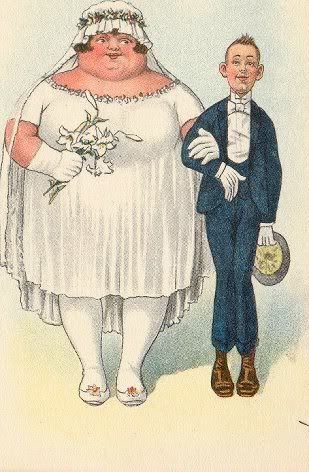
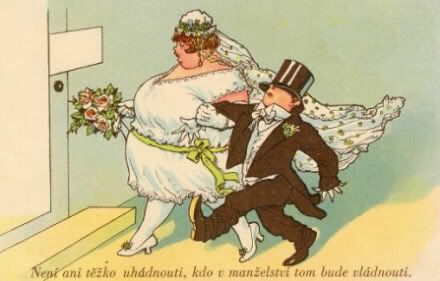
Looks like this Thiele BBW is indulging in some cradle robbing, doesn't it?


On the Beach II
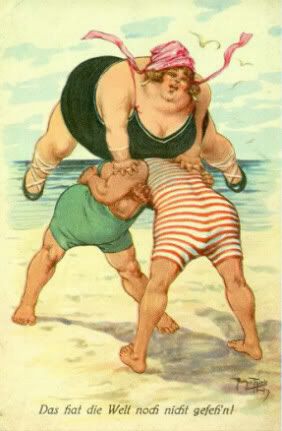
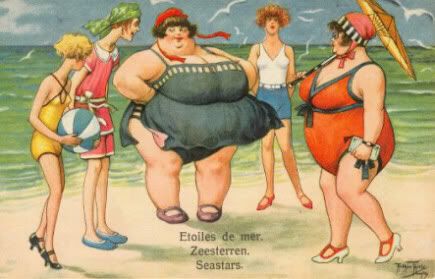
Here's yet another amazing Arthur Thiele summer holiday card. Who sez that fat women aren't athletic?


Sunday, November 15, 2009
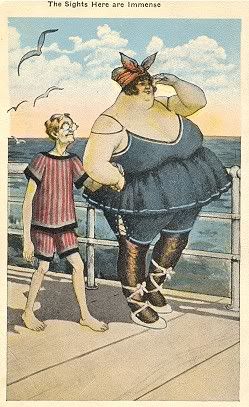
On the Pier
My old Geocities site devoted to fat themed postcards has bitten the dust, so until I find the time to put together a new set of pages devoted to 'em, I've decided to start posting some of my favorite cards here. First up, is an item by the great Belgium artist Arthur Thiele:


Sunday, August 09, 2009
Adventures in Being Edited
Rearranging some boxes in the study recently, I came upon some men's mag with a few of my stories in 'em. It'd been since some time since I'd cracked the pages of one of these disreputable li'l periodicals, so I grabbed the March '95 ish of Plumpers and Big Women, which featured one of my restaurant stories, "Consuming Interests." I remembered being dissatisfied with the tale (retitled "Consuming Love" for its print appearance), though I couldn't recall what the big issue was.
Once I got into it, I remember, though. Plumpers' editors were more hands-on than a lotta men's mag overseers, and they made some half-assed changes that I as the writer found maddening. First came in the story's opening. "Consuming" is about a girl, Tammy Tantalus, who inherits a bunch of Italian restaurants from her uncle after he's shot to death by a jealous husband. In the opening paragraph, the editors changed the motive behind his murder, making Uncle Dom the victim of a gangland shooting spurred by unpaid gambling debts. Problem with this revision is they didn't keep it consistent throughout the story: a later joking reference to that cuckolded killer was kept in the text.
Even more irritating, the editors cut "Consuming" off after its climactic sex scene, slicing off character details that I rather liked and a decent weight gain postscript. The basic story is about a Machiavellian maitre-d who schemes to get the health food conscious heiress addicted to her restaurants' offerings so she won't initiate any big changes in their menus. As she grows, the maitre-d's attraction for Tammy similarly grows, and as part of the reveal, I made it clear that Tammy is not the innocent her scheming feeder believes her to be.
But this little detail was left off the tale. Instead, we end with the two post-coitus, with a jowly Tammy smiling up at her lover and saying, "I guess this is a very happy ending!" Well, not really, I thought, when I received my contributor's copy of PBW in the mail. Fortunately, in the intervening years, the Internet has afforded me the opportunity to post what Paul Harvey would've called the Rest of the Story, so I guess I can't grouse too much. . .
Once I got into it, I remember, though. Plumpers' editors were more hands-on than a lotta men's mag overseers, and they made some half-assed changes that I as the writer found maddening. First came in the story's opening. "Consuming" is about a girl, Tammy Tantalus, who inherits a bunch of Italian restaurants from her uncle after he's shot to death by a jealous husband. In the opening paragraph, the editors changed the motive behind his murder, making Uncle Dom the victim of a gangland shooting spurred by unpaid gambling debts. Problem with this revision is they didn't keep it consistent throughout the story: a later joking reference to that cuckolded killer was kept in the text.
Even more irritating, the editors cut "Consuming" off after its climactic sex scene, slicing off character details that I rather liked and a decent weight gain postscript. The basic story is about a Machiavellian maitre-d who schemes to get the health food conscious heiress addicted to her restaurants' offerings so she won't initiate any big changes in their menus. As she grows, the maitre-d's attraction for Tammy similarly grows, and as part of the reveal, I made it clear that Tammy is not the innocent her scheming feeder believes her to be.
But this little detail was left off the tale. Instead, we end with the two post-coitus, with a jowly Tammy smiling up at her lover and saying, "I guess this is a very happy ending!" Well, not really, I thought, when I received my contributor's copy of PBW in the mail. Fortunately, in the intervening years, the Internet has afforded me the opportunity to post what Paul Harvey would've called the Rest of the Story, so I guess I can't grouse too much. . .
Saturday, July 25, 2009
Diva-licious
I've gotta discuss Drop Dead Diva.
This is, admittedly, a bit difficult for me because, frankly, I'm more than a little jealous of Josh Berman, who created and sold this show to Lifetime. A fantasy dramedy about a thin woman who dies and comes back to life as a brainy BBW lawyer? Heaven Can Wait meets Eli Stone in the world of "Fat Magic"? Yeah, I wish I had a piece of that action.
But now I've watched the first two eps of the show, and I've (almost) managed to get past my soul-gnawing envy. Credit a lead (Brooke Elliot) who is both appealing and skilled at conveying the warring personalities her plus-sized frame. It's the series' conceit that while slim dead ditz Deb is the primary occupant of the full-figured lawyer's bod, she possesses the previous owner's memories, knowledge and appetites. This creates some decent comic moments that may, at times, flirt with fat stereotypes without fully yielding into 'em. As one who enjoys exploring the line between type and individual character, that's fine with me.
The show's prime interest, then, rests in seeing how two very disparate women – one, a worshipper of the superficial and flashy, the other a brainy workaholic with a predilection for "sensible" clothes – learn to take the best aspects of each life and create an even stronger person. The trick is to dramatize this fusion without being too obvious or didactic about it. In the first two episodes, at least, some smart dialog coupled with Elliott's performance managed to pull it off.
The only time Diva flags for this viewer is when it focuses too much on dead Deb's equally pipe cleaner-y friend Kim (Kate Levering), who knows that her friend is trapped in another's body and cheerfully espouses fat-slapping self-help advice to her friend at every opportunity. A little of this goes a long way, though perhaps we'll see the character's attitude toward her fat-sized sisters evolve over time.
In short, a decent summer program – and the first thing I've set aside to watch on Lifetime since they stopped airing Medium reruns. Let's hope the show holds up over the rest of the summer.
This is, admittedly, a bit difficult for me because, frankly, I'm more than a little jealous of Josh Berman, who created and sold this show to Lifetime. A fantasy dramedy about a thin woman who dies and comes back to life as a brainy BBW lawyer? Heaven Can Wait meets Eli Stone in the world of "Fat Magic"? Yeah, I wish I had a piece of that action.
But now I've watched the first two eps of the show, and I've (almost) managed to get past my soul-gnawing envy. Credit a lead (Brooke Elliot) who is both appealing and skilled at conveying the warring personalities her plus-sized frame. It's the series' conceit that while slim dead ditz Deb is the primary occupant of the full-figured lawyer's bod, she possesses the previous owner's memories, knowledge and appetites. This creates some decent comic moments that may, at times, flirt with fat stereotypes without fully yielding into 'em. As one who enjoys exploring the line between type and individual character, that's fine with me.
The show's prime interest, then, rests in seeing how two very disparate women – one, a worshipper of the superficial and flashy, the other a brainy workaholic with a predilection for "sensible" clothes – learn to take the best aspects of each life and create an even stronger person. The trick is to dramatize this fusion without being too obvious or didactic about it. In the first two episodes, at least, some smart dialog coupled with Elliott's performance managed to pull it off.
The only time Diva flags for this viewer is when it focuses too much on dead Deb's equally pipe cleaner-y friend Kim (Kate Levering), who knows that her friend is trapped in another's body and cheerfully espouses fat-slapping self-help advice to her friend at every opportunity. A little of this goes a long way, though perhaps we'll see the character's attitude toward her fat-sized sisters evolve over time.
In short, a decent summer program – and the first thing I've set aside to watch on Lifetime since they stopped airing Medium reruns. Let's hope the show holds up over the rest of the summer.
Friday, July 24, 2009
Baird And Barbers Collaborate?
Another "Lew Baird" story has been recently resurrected from unfinished manuscript limbo and completed by yours truly. Featuring the reality shifting hero of Baird's earlier transformation trilogy ("Marianne/Mare," "Patricia/Pat/Patti," & "Rachel's Story") it's an admittedly unbelievable tale of one young woman's Big Change in the American Southwest. You can find this little fantasy, "Sophie/Sofia," on Dimensions Magazine Online's "Fat Magic" page.
As always, comments are welcome.
Friday, February 27, 2009
Monday, February 16, 2009
A Small Thought on Cultural Bias
So we're watching a Discovery Channel documentary on the "The Science of Sex Appeal," and we get to a part where they're discussing the 7/10 ratio – that magical ration between waist and hips that are alleged by cultural anthropologists to represent the maximum ideal of female sexual attractiveness. Using computer images, recently, scientists presented an "average group" of men with a variety of different ratios, though, and came up with one that was sparked even more arousal in their subject's lizard brains: a 5/10 ratio. This Barbie doll-styled ratio isn't even natural, the show asserted, and it showed a doll-like figure with an unnaturally pinched waist to illustrate this point.
Naturally, the FA in me thought to protest: "You're keeping the butt the same size and shrinking the waist. Why not increase the butt and keep the waist close to its old measurement?" Now we're talkin' ancient goddess figures, right? Think I saw one of those, pushing a cart at Thriftee just the other day . . .
Sunday, January 11, 2009
Detrimentality
Foolishly got myself pulled into a thread on one of the Dimensions boards this weekend. One of the board regulars, taking several WG fantasy images by two FA artists and posting them out of context, asked if these images were "detrimental to size acceptance." It's a loaded question, and it drew out the inevitable responses: posts by fat women and men who were offended by the images, slamming both their creators and those who find them appealing; expressions of "concern" for those innocent newcomers to the site who come upon these images for the first time; corollary statements about what mainstream America might think if they saw the images, and so on.
Some of this grew pretty nasty (and, to be honest, I wouldn't be surprised if the original poster, a self-described "shit-stirrer," hadn't intended it that way), but it was also depressingly familiar. This isn't the first time that self-proclaimed size-acceptance advocates have taken umbrage over outlandish fantasy imagery, and it won't be the last. I do feel badly for those writing and drawing fanta-sizers who wander into this discussion for the first time. Ideally, all artists would be thick-skinned enough to withstand the nattering nabobs of negativism (to pull out an old Agnew-ism), but, of course, that's not the case.
My own belief is that fantasy shouldn't be bound by questions about "What's good for the movement," but, then, I would believe that, wouldn't I? I do think that the basic ideals of size acceptance run so counter to the mainstream (I'm writing this in the middle of the annual New Year's Diet advertizing blitz, after all) that even if there weren't the works of a bunch of active fanta-sizers out there, the Dimensions community of fat women & men and their admirers would be viewed as just plain aberrant . . .
Some of this grew pretty nasty (and, to be honest, I wouldn't be surprised if the original poster, a self-described "shit-stirrer," hadn't intended it that way), but it was also depressingly familiar. This isn't the first time that self-proclaimed size-acceptance advocates have taken umbrage over outlandish fantasy imagery, and it won't be the last. I do feel badly for those writing and drawing fanta-sizers who wander into this discussion for the first time. Ideally, all artists would be thick-skinned enough to withstand the nattering nabobs of negativism (to pull out an old Agnew-ism), but, of course, that's not the case.
My own belief is that fantasy shouldn't be bound by questions about "What's good for the movement," but, then, I would believe that, wouldn't I? I do think that the basic ideals of size acceptance run so counter to the mainstream (I'm writing this in the middle of the annual New Year's Diet advertizing blitz, after all) that even if there weren't the works of a bunch of active fanta-sizers out there, the Dimensions community of fat women & men and their admirers would be viewed as just plain aberrant . . .
Thursday, January 01, 2009
Monday, December 29, 2008
The Divine Miss L.
For those of you who haven't seen a picture of Klaus Nordling's comic book fat lady Lena, here's a panel of her:

(For the record, this is from the 1948 Spring Issue of Quality Comics' The Barker, issue #7.)

(For the record, this is from the 1948 Spring Issue of Quality Comics' The Barker, issue #7.)
Friday, December 26, 2008
A New Tale for Xmas
Posted my first new Wilson Barbers (as opposed to "Lewis Baird") WG story for the year on the Dimensions site: "One of Us" is a story that I've probably worked my way toward writing for several years, combining as it does my long-standing fascination with old-fashioned circus and sideshow fat ladies, in particular. The piece originally was created two years ago as a script for a proposed web comic to be illustrated by the FA artist BeakerFA, who provided some feedback on my plotting as I worked on it. Unfortunately, other commitments kept Beak' from being able illustrate the 75-episode strip, so last summer I started the task of transforming script into a full text story. Beaker contributed three illustrations to the new version, the first of which should give you an idea of what we were going for:
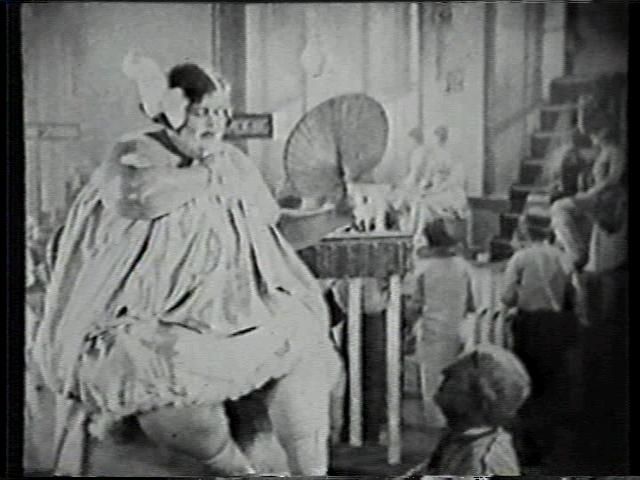
I love this graphic for the way it captures my rapturously singin' heroine and her soon-to-be lover Earl (the name was inspired by movie midget actor Harry Earle) and the ten-in-one tent show setting. Gotta admit, though, the first time I saw it, my initial response was a picky technical one. In the story, there's a moment where I mention Betty's lower belly knocking off an audience member's hat with her belly (it's meant to anticipate a story action that occurs a bit later). Looking at the graphic, I had to wonder whether that was even possible. Describing the ten-in-one, I was originally thinking of a somewhat lower platform on the level of this 'un (from the movie The Unholy Three):

It's a small point, but it does illustrate how differently two minds can visualize the same moment. I added a descriptor indicating that the hatless Rube was very very tall to the story, so mebbe it doesn't matter. In any event, the results of both our work can be found here.
I love this graphic for the way it captures my rapturously singin' heroine and her soon-to-be lover Earl (the name was inspired by movie midget actor Harry Earle) and the ten-in-one tent show setting. Gotta admit, though, the first time I saw it, my initial response was a picky technical one. In the story, there's a moment where I mention Betty's lower belly knocking off an audience member's hat with her belly (it's meant to anticipate a story action that occurs a bit later). Looking at the graphic, I had to wonder whether that was even possible. Describing the ten-in-one, I was originally thinking of a somewhat lower platform on the level of this 'un (from the movie The Unholy Three):

It's a small point, but it does illustrate how differently two minds can visualize the same moment. I added a descriptor indicating that the hatless Rube was very very tall to the story, so mebbe it doesn't matter. In any event, the results of both our work can be found here.
Sunday, August 24, 2008
Fat Magic Moments
Took me longer to "edit the original ms." than I expected, but I've posted the third "Lewis Baird story" on the Dimensions website this weekend. Entitled "Rachel's Story," it's a longish piece narrated by the wife of the unnamed mystery man who tells the first two Baird tales, "Marianne/Mare" and "Patricia/Pat/Patti," and it provides a skosh more background info about this inexplicably powerful figure. I enjoyed working on the Baird finale, even though it took much longer for me to wind it up satisfactorily than I originally expected.
Some readers (including Dim publisher Conrad Blickenstorfer) aren't much fond of the political themes imbedded in the first two stories, but to my eyes they needed to be there. One of the original impetuses behind this trilogy was my desire to work a theme that appears in a lot of Internet WG stories (perhaps best repped by the prolific Matt L.) of fatness being connected with lower class status. When more than one study shows a clear correlation between size and income levels (with fat workers frequently making less than their equally qualified thinner peers), this strikes me as legitimate material for fanta-sizer fiction. Once you start talking about class, it's a short step into writing about politics.
Reading some of my fellow fanta-sizers' offerings - where the initially haughty heroines' weight gain was tied into their dropping down in social status - I've long been struck by the writers' ambivalent attitude toward class. On the one hand, we're meant to see the character's weight gain as sexy, but, on the other, their diminution in class is treated with a clear measure of scorn. With the Baird stories, I tried to wrestle with this very American inner conflict, and I think I finally got it right in the third 'un . . .
Some readers (including Dim publisher Conrad Blickenstorfer) aren't much fond of the political themes imbedded in the first two stories, but to my eyes they needed to be there. One of the original impetuses behind this trilogy was my desire to work a theme that appears in a lot of Internet WG stories (perhaps best repped by the prolific Matt L.) of fatness being connected with lower class status. When more than one study shows a clear correlation between size and income levels (with fat workers frequently making less than their equally qualified thinner peers), this strikes me as legitimate material for fanta-sizer fiction. Once you start talking about class, it's a short step into writing about politics.
Reading some of my fellow fanta-sizers' offerings - where the initially haughty heroines' weight gain was tied into their dropping down in social status - I've long been struck by the writers' ambivalent attitude toward class. On the one hand, we're meant to see the character's weight gain as sexy, but, on the other, their diminution in class is treated with a clear measure of scorn. With the Baird stories, I tried to wrestle with this very American inner conflict, and I think I finally got it right in the third 'un . . .